PayerUnitedHealthcare · StateTexas · CPT90837 — Psychotherapy, 60 min · Vintage2026 Q1 · SourceMarch 2026 · Confidence High

See where UHC's reported Texas rates cluster for CPT 90837.

Built from the payer file layer published under federal law. The report shows sample size, percentile spread, and a Medicare reference before you buy.

Credential level

Data vintage: March 2026 source snapshot. Release ID and source snapshot are included in the PDF provenance block.

Rate Distribution Preview High Confidence
Median Contracted Rate — CPT 90837
$110
−14% vs Medicare ($128.25)
P10P25P50 (median)P75P90
IQR band (P25–P75)
Median
Medicare
$103
P25
$110
P50 Median
$120
P75
$147
P90

P25, P75, and P90 unlocked in the full report. Get notified →

Providers in cohort 6,569
Rate types included Negotiated · Fee Schedule

Two pages from the actual report

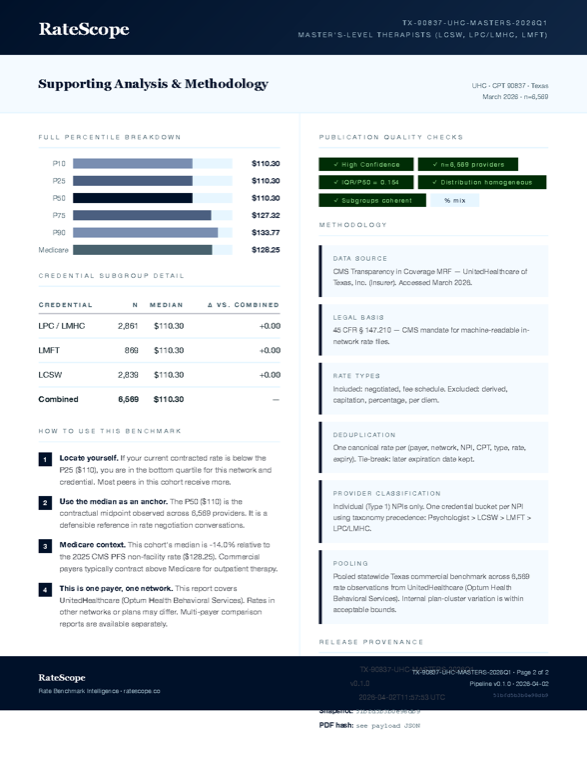
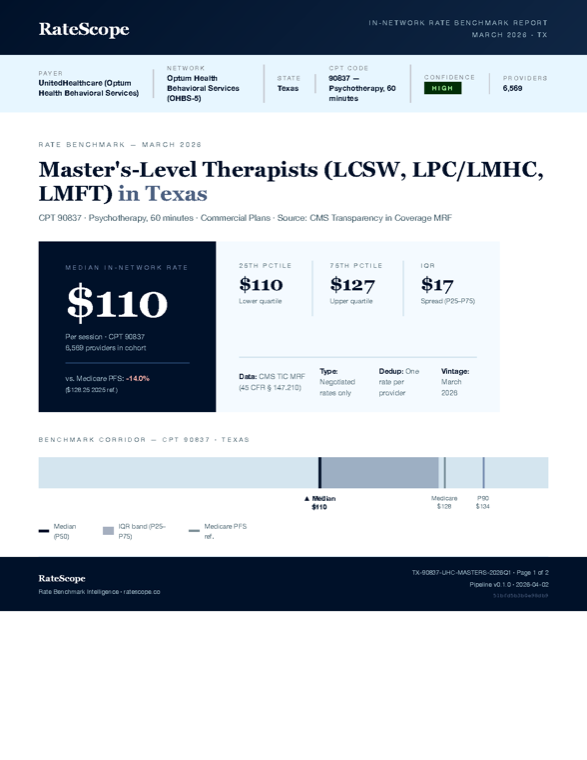
The full PDF contains four pages: summary, percentile analysis, per-credential breakdown, and methodology + QA. Reproducible — same payload hash every time.
Sample page 1 — summary with median, corridor, and Medicare anchor
Page 1 — Summary
Sample page 2 — percentile table, methodology, QA block
Full distribution unlocked in PDF
Page 2 — Analysis & Methodology
Get notified when available

What's in the report

A frozen PDF with reproducible methodology — not a dashboard you log into, not a "score." A citable document you can use in a negotiation conversation.

P

Full percentile distribution

P10 through P90 for your credential level — where reported rates cluster, not just a midpoint. Includes the IQR and a concentration note if rates bunch tightly.

M

Medicare reference anchor

Every rate is indexed against the 2025 Medicare allowable for CPT 90837 in Texas ($128.25), so you can place the benchmark against a familiar reimbursement anchor.

C

Credential subgroup breakdown

For master's-level reports: median by sub-credential (LCSW vs LMFT vs LPC). Shows whether your license type sits above or below the pooled line.

Q

QA provenance and methodology

Data source, provider count, T3-T6 pipeline decisions, confidence tier, and source snapshot. Everything needed to inspect how the number was built.

B

Benchmark corridor graphic

A visual IQR band showing where 50% of contracted rates fall. Includes Medicare reference line and your credential median clearly marked.

G

Negotiation usage guide

4-step protocol for reading the percentile table, framing a counter-offer, and responding when the payer says "this is our standard rate."

Not included: your specific contracted rate (we don't have it — no one does except you and UHC), individual NPI lookups, predictions about what UHC will agree to, or legal advice. This is benchmark data. What you do with it is your call.

Group practice owner

Reviews five clinicians' current UHC rates against the statewide benchmark and identifies which contracts sit near the low end of the published distribution.

Solo LCSW

Compares a current rate against the reported distribution and decides whether a renewal conversation is worth having with something more concrete than rumor.

Credentialing specialist

Advises a new provider on whether the panel economics look workable relative to cash-pay alternatives before signing a contract.

What is controlled

  • ✓ Single payer: UnitedHealthcare behavioral health network
  • ✓ Single CPT code: 90837 (psychotherapy, 60 min)
  • ✓ Single state: Texas
  • ✓ FFS rates only — negotiated and fee schedule; derived excluded
  • ✓ One rate per NPI after canonical dedup
  • ✓ Credential bucket by NPPES taxonomy (one bucket per provider)

What remains variable

  • ~ Your individual contract terms with UHC
  • ~ Modifier usage (e.g., telehealth, place-of-service codes)
  • ~ Regional sub-variation within Texas
  • ~ Credentialing and panel status changes after March 2026
  • ~ Whether your NPI appears in the UHC network file
Full limitations and methodology: ratescope.co/methodology

Get the full benchmark report

$79 one-time · instant PDF delivery
  • Full percentile table (P10–P90)
  • Benchmark corridor graphic (PDF-ready)
  • Credential subgroup breakdown
  • Medicare comparison anchor
  • QA provenance block + payload hash
  • Negotiation usage guide
  • Frozen report — same file, every time
  • Per-clinician earnings impact table at P25, P50, and P75 rates
If the PDF does not render correctly or contains an obvious data error, email us and we'll refund within 48 hours. We do not offer refunds because the data didn't match your expectation — the methodology is published in full before you buy.
Selected credential
Master's Level (LCSW · LPC · LMFT) change
UHC Texas · 90837 · Master's Level · 2026 Q1 TX-90837-UHC-MASTERS-2026Q1
n 6,569 providers Confidence High Source March 2026 Cohort TX · FFS only

Checkout is not live yet for this exact report. Leave your email and we will send one availability email when it opens.

Source

UHC public payer file published under 45 CFR § 147.210, using the relevant behavioral health network snapshot for this benchmark.

Provider matching

NPIs matched to NPPES March 2026 bulk dissemination file. Credential bucket assigned by taxonomy code; one provider, one bucket.

Rate inclusion (T3)

Only "negotiated" and "fee schedule" rate types. "Derived" rates excluded. One rate per NPI after dedup by (NPI, rate, expiration date).

Confidence (T6)

High: n ≥ 100, IQR/median ≤ 0.50. Moderate: n ≥ 30. Both cohorts in this report qualify as High confidence.

Full methodology: ratescope.co/methodology

Questions about this report

Is this my rate?
No. This is a statewide cohort benchmark — the distribution of contracted rates across all Texas therapists in UHC's behavioral health network for CPT 90837. Your individual contract rate depends on your specific agreement with UHC. The benchmark tells you where your rate sits relative to others and how it compares to Medicare, not what UHC will offer you.
How current is the data?
This report is built from a March 2026 source snapshot. The PDF includes the release ID and source snapshot so you can tell exactly which version you are reading.
Why is the median below Medicare?
For master's-level therapists, the median contracted rate for 90837 in Texas ($110.30) sits about 14% below the 2025 Medicare allowable ($128.25). This is common in commercial markets where payers benchmark commercial rates against Medicare but often negotiate below for behavioral health. The psychologist cohort median ($147.07) runs about 15% above Medicare for the same code.
Can I use this in a negotiation with UHC?
Yes. The report gives you a documented benchmark with a visible methodology. It will not tell you what UHC must do, but it does give you a more credible starting point than hearsay or a generic state average.
What's the difference between master's and psychologist reports?
The two credential buckets are computed separately from the same source snapshot. Master's-level and psychologist cohorts show up at different reimbursement levels, and both clear the High-confidence threshold.
Is this legal to publish?
Yes. The data originates from UHC's publicly-required Machine-Readable Files under 45 CFR § 147.210 (Transparency in Coverage rule). CMS explicitly authorizes third-party aggregation, analysis, and republication of MRF data. We publish aggregate statistics only — not individual provider rate lookup.
Who buys this?
Group practice owners use it for panel management decisions across multiple clinicians — one purchase covers context for your entire team. Solo therapists use it to evaluate whether their current UHC rate is competitive before renewal. Credentialing specialists use it as a reference when advising providers on new panel decisions.
Why $79?
A $15/session rate difference — say, being at $95 instead of the $110.30 median — is $18,000/year per clinician at 25 sessions per week across 48 weeks. The report costs less than one session billed at the median rate. For a group practice with five clinicians each negotiating $10 more per session, the data pays for itself in the first hour.
What is your refund policy?
If the PDF does not render correctly or contains an obvious data error, email us within 48 hours and we'll refund in full. We do not offer refunds because the data didn't match your expectation or contract situation — the methodology, scope, and sample size are published in full before you buy. Read the Scope and Limits section above before purchasing.
Can I share the report with my team?
Yes — within your organization. One purchase covers internal use by your practice, billing team, or credentialing staff. You may not redistribute, resell, or publish the report externally. The report contains a release ID and payload hash that identify the specific purchase.
Does the report include individual provider rates or NPI lookups?
No. RateScope publishes aggregate cohort statistics only — medians, percentiles, and distributions across the defined provider group. Individual NPI rates are not disclosed. This is by design: the benchmark value is in the distribution, not in identifying what any specific provider earns.