Data source Payer files published under federal law
Coverage Loading live coverage...
Current vintage Loading vintage...
Dataset Loading provider count...
Preview rule High-confidence cells only

See where this payer's reported rates cluster.

Texas benchmark reports for UHC and BCBS Texas, built from payer files published under federal law. Sample size, percentile spread, and methodology are visible before you buy.

Loading live reports...
Built from payer files published under federal law Loading live report counts... Percentiles, sample size, and methodology shown before purchase One-time purchase, no subscription
A $15/session gap can move annual revenue by five figures for a full clinician panel. The report is meant to reduce uncertainty before you decide to stay, leave, or push on a contract.
Master's-Level (LCSW, LPC, LMFT)
Psychologist
Loading featured preview... High
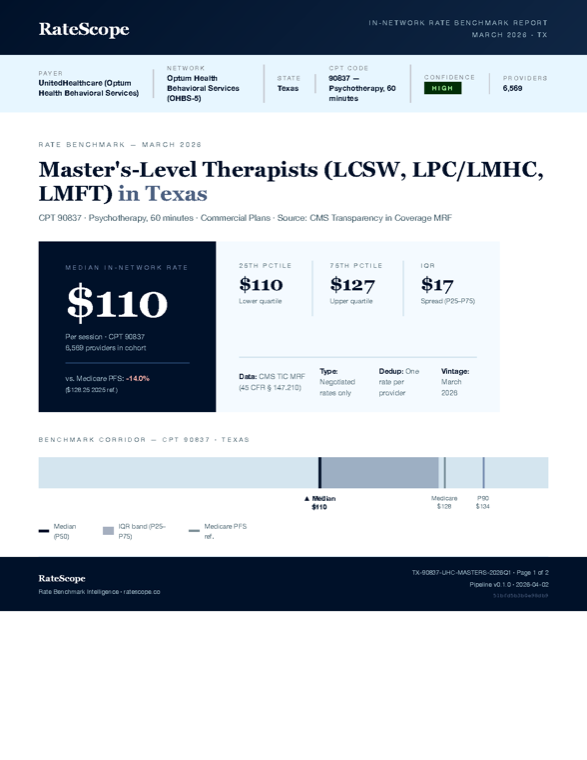
Median rate (P50) --
------
IQR (P25-P75) Median Medicare $128
25th percentile --
75th percentile --
90th percentile --
View methodology before you buy →

Scoped to a decision

Each report is tied to one payer, one code, one state, and one credential bucket. You can tell what you are looking at before you buy.

More than an average

You see the median and the surrounding percentile spread, not a hand-wavy range with no sample size behind it.

Evidence you can inspect

Methodology is published before purchase, so you can judge the benchmark on scope, exclusions, and confidence instead of trusting a black box.

Report page 1 — summary Summary page
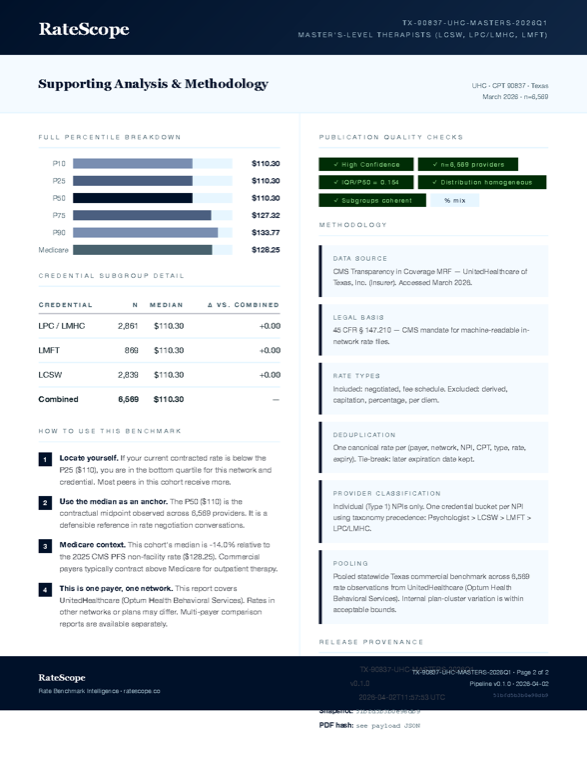
Report page 2 — analysis and methodology Distribution + methodology
Also included
  • ✓ P10 through P90 distribution
  • ✓ Medicare reference anchor
  • ✓ Credential subgroup breakdown
  • ✓ Negotiation usage guide
  • ✓ Release ID + source snapshot
One-time purchase $79 Instant PDF delivery · No subscription
View featured report - $79

The files are public. The usable benchmark is not.

Payers publish these files because federal law requires it. That does not make them easy to use when you are trying to evaluate a panel, a renewal, or whether a rate is unusually low.

RateScope turns that raw file layer into a scoped benchmark: Texas, CPT 90837, credential bucket, sample size, percentile spread, and a method you can inspect before purchase.

This is observational data from a dated source file. It does not predict your individual contract offer. It helps you locate your current rate against a defined market snapshot.

1
Select the exact benchmark. Choose payer and credential bucket. Scope is explicit before you buy, so you know whether the report fits your decision.
2
Buy it directly. One-time purchase, $79. No subscription, no demo request, no form-gated sales flow.
3
Use it in a panel or contract decision. The report gives you a documented median, percentile spread, and methodology you can cite in a reimbursement conversation.

Available Reports

Loading

Loading live reports...

Homepage catalog is loading.

Common questions

How is this different from free rate guides?

Most free guides give you a broad range or a survey-style average. RateScope shows a scoped benchmark for one payer, one code, one state, and one credential bucket, with sample size and methodology visible before purchase. You can inspect the evidence instead of guessing how the number was built.

What exactly is in the report?

A PDF containing the median and surrounding percentile spread for CPT 90837, a benchmark corridor visualization, comparison to the 2025 Medicare PFS non-facility rate, credential subgroup notes for the master's-level cohort, and the methodology used to build the benchmark. See the methodology page for the full process.

Where does this data come from?

The underlying source is the payer file layer published under 45 CFR § 147.210, the Transparency in Coverage rule. We turn that raw file layer into a therapist-facing benchmark by filtering to the relevant code, resolving the Texas provider cohort, and publishing the sample size and scope alongside the result.

Can I use this to negotiate my rate?

Yes. The report is meant to help you evaluate whether your current rate looks unusually low, whether a panel is still worth it, or whether a contract conversation is justified. It is not legal or contracting advice, but it gives you a concrete benchmark to reference instead of relying on rumor.

Is this the rate I'll be offered if I join a panel?

No. This is a market snapshot, not a promise about your personal contract. Your offer can still vary by credential, contract terms, geography, and payer logic. The value of the report is that it helps you see where your current or proposed rate sits against the reported distribution.

How current is the data?

Each report carries a data vintage and release identifier so you know exactly which snapshot you are reading. The current live reports on this site use March 2026 source data, and the intent is to refresh them on a regular cadence as new snapshots are validated.

Who is this for?

It is written to be useful for both solo clinicians and practice operators. A solo therapist can use it to see whether their current rate seems out of line. A group owner can use it to compare panel economics across credential types before deciding where to push.